
BPO stands for Business Process Outsourcing, which means hiring a third party company to handle specific business tasks instead of managing them in-house.Businesses use BPO to reduce costs, improve efficiency, access specialized expertise, and focus on their core operations.
Whether you own a startup, a growing business, or a large enterprise, understanding BPO can help you decide if outsourcing is the right choice for your company.
In this blog, we have discussed what a BPO is, it’s different types and some real-life examples.
What is BPO in Business?
BPO is a business strategy where companies outsource certain operations to specialized providers. The goal is not simply to cut costs. It is also about improving efficiency and allowing internal teams to focus on activities that directly contribute to business growth.
For example:
- An ecommerce company may outsource its customer support while keeping product development and marketing in house.
- A healthcare provider may outsource medical billing so doctors and staff can focus on patient care.
- A software company may outsource technical support to provide 24 hour assistance to customers across different time zones.
According to Auxis, in 2026, IT outsourcing is being driven by skills rather than labor costs. Organizations increasingly seek outsourcing partners to bridge technology execution gaps, with Generative AI and agentic AI capabilities becoming top selection criteria for outsourcing providers.
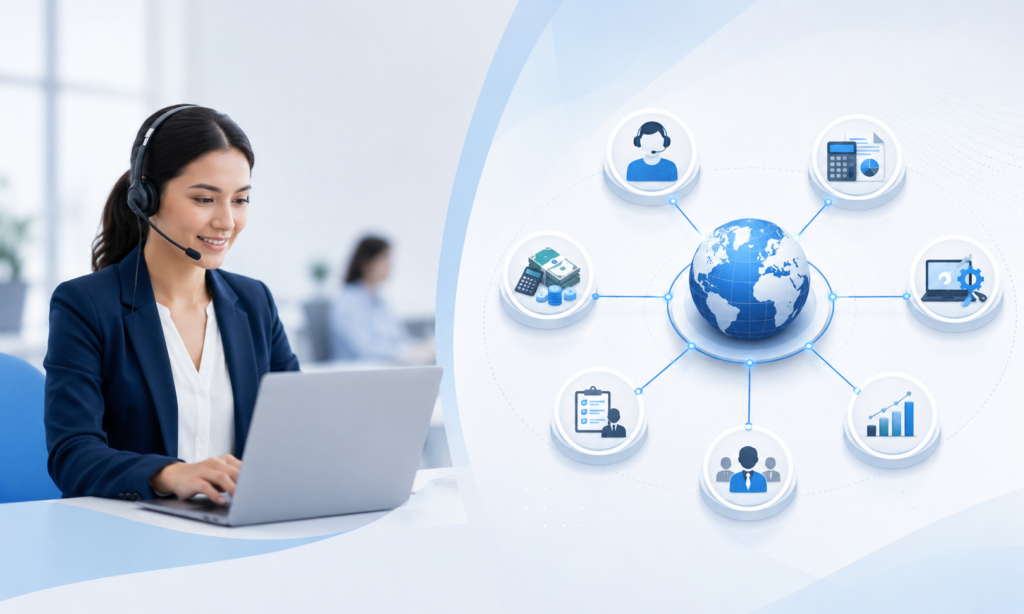
What Does a BPO do for a Business?
- Customer support
- Technical support
- Payroll
- Human resources
- Data entry
- Accounting
- IT services
- Marketing support
- Appointment scheduling
- Back office administration
Instead of hiring full time employees for every department, many businesses outsource these tasks to experienced service providers. This helps them save time, lower operational costs, and improve productivity.
What are the Types of BPO?
Here are different types of BPO based on the services a company outsources and where the outsourcing partner is located.
1. Front Office BPO
- Customer support
- Technical support
- Sales
- Live chat support
- Help desk services
- Appointment scheduling
Many businesses outsource front office operations to improve response times and provide customer support around the clock.
2. Back Office BPO
- Accounting
- Payroll
- Human resources
- Data entry
- IT administration
- Procurement
- Compliance support
Outsourcing these functions allows businesses to save time while improving accuracy and efficiency.
3. Offshore BPO
Offshore BPO means outsourcing work to a company located in another country.
For example, a business in the United States may outsource customer support or accounting to a provider in the Philippines or Pakistan.
Companies often choose offshore BPO to lower operating costs, access skilled professionals, and provide support across multiple time zones.
4. Nearshore BPO
Nearshore BPO involves outsourcing business functions to a company in a neighboring country.
For example, a company in the United States may partner with a service provider in Mexico, while a business in Germany may outsource to Poland.
Because of similar time zones and shorter travel distances, nearshore outsourcing often makes communication and collaboration easier.
5. Onshore BPO
Also known as domestic outsourcing, onshore BPO means hiring a service provider within the same country.
For example, a business in Texas may outsource payroll to a company in Florida.
Although onshore BPO may cost more than offshore outsourcing, it often offers better language compatibility, easier collaboration, and fewer regulatory concerns.
BPO vs Call Center: What's the Difference?
Understanding BPO vs call center is important if you are planning to outsource business operations.
Feature | BPO | Call Center |
Scope | Covers many business functions | Focuses mainly on phone support |
Services | Customer service, HR, payroll, finance, IT, data entry, marketing support | Inbound and outbound calls |
Customer Interaction | May or may not involve customers | Always involves customer communication |
Main Goal | Improve overall business efficiency | Handle customer communication efficiently |
Examples | Payroll outsourcing, virtual assistants, bookkeeping, technical support | Customer service hotline, telemarketing, help desk |
If your business only needs phone support, a call center may be enough. However, if you want help with multiple business functions, a BPO provider is the better choice.
Front Office BPO vs Back Office BPO
Businesses often compare front office BPO vs back office BPO before deciding which services to outsource
Feature | Front Office BPO | Back Office BPO |
Main Focus | Customer interaction | Internal operations |
Customer Contact | Yes | No |
Examples | Customer service, sales, technical support | Payroll, accounting, HR, data entry |
Business Goal | Improve customer experience | Improve operational efficiency |
Performance Measured By | Customer satisfaction and response times | Accuracy, speed, and productivity |
Many businesses outsource both front office and back office operations to improve overall efficiency.
Industries That Use BPO
- Healthcare
- Finance and banking
- Ecommerce
- Retail
- Information technology
- Telecommunications
- Insurance
- Real estate
- Legal services
- Travel and hospitality
- Logistics and transportation
- Manufacturing
Whether it is processing insurance claims, managing payroll, or answering customer questions, BPO helps businesses operate more efficiently.
BPO Examples and Trends
Here are some BPO examples and trends to help you understand how businesses use outsourcing.
1. Healthcare
BPO helps with billing, claims, scheduling, and reminders. It saves time and lowers office work. The healthcare BPO market is around $58.4 billion in 2026, and companies can save 40 to 60 percent on admin costs by outsourcing these tasks.
2. Retail and e-commerce
BPO helps online stores answer customers, track orders, handle returns, and manage chat. This is useful when sales get busy. In 2026, customer service outsourcing is a very large market, and retail customer service outsourcing is expected to keep growing strongly.
3. Technology and SaaS
BPO helps software companies with support, onboarding, CRM updates, and user help. This lets them grow faster without hiring too many people too soon. Many SaaS companies now use outsourcing to stay flexible and keep service quality steady.
4. Travel and hospitality
BPO helps with bookings, tickets, cancellations, and guest support. This keeps service open all the time. Travel companies use it because customers want quick help, especially when plans change.
5. Real estate
BPO helps with lead follow-up, tenant questions, viewings, and paperwork. This helps agents reply faster and close more deals. It also gives them more time to focus on clients.
6. Education
BPO helps schools and learning platforms with admissions, student support, LMS help, and parent communication. This makes it easier to handle many questions at once. Education outsourcing keeps the team from getting overloaded.
Benefits of Business Process Outsourcing

Here are some benefits of BPO for businesses.
Lower Operating Costs
Outsourcing reduces expenses related to hiring, training, salaries, office space, and equipment. Businesses can access skilled professionals without the overhead of building an in house team.
Access to Experienced Professionals
BPO providers have trained professionals across different business functions. This gives businesses immediate access to specialized skills without spending time on recruitment and training.
Faster Business Growth
Outsourcing routine tasks frees up time for business owners and managers to focus on growth, innovation, and customer acquisition.
Improved Customer Service
BPO providers deliver professional support through phone, email, chat, and social media. Faster response times and better service improve the overall customer experience.
Increased Productivity
By outsourcing repetitive tasks, internal teams can focus on high value work. This improves efficiency and helps employees accomplish more.
Easier Business Scaling
BPO companies can quickly increase or decrease support as business needs change. This flexibility makes it easier to manage seasonal demand or business growth.
Better Focus on Core Business Activities
Outsourcing administrative and operational tasks allows businesses to concentrate on activities that drive revenue, such as product development, sales, and marketing.
Access to Modern Technology
Many BPO providers use advanced software, automation tools, and secure systems. Businesses can benefit from these technologies without making large upfront investments.
Round the Clock Support
Many BPO providers operate across multiple time zones, making it possible to offer 24/7 customer support and business operations.
Outsourcing helps businesses reduce costs, improve efficiency, and focus on long term growth while leaving day to day operations in capable hands.
Are There Any Challenges?
- Communication issues when working across different time zones
- Data security concerns if the provider lacks proper safeguards
- Less direct control over outsourced teams Service quality differences between providers.
Most of these challenges can be avoided by choosing an experienced and reliable BPO partner, setting clear expectations, and maintaining regular communication.
Frequently Asked Questions
Can a business use both inbound and outbound telemarketing at the same time?
Absolutely, and most successful businesses do. Outbound helps you bring new customers in while inbound takes care of the ones you already have. Using both together creates a more complete sales and support operation that drives both growth and retention.
Is outbound telemarketing still effective in 2026?
Absolutely. 69% of buyers are open to outbound calls and 82% say they would meet with a rep who reaches out with real value. 57% of C-suite executives still prefer the phone over any other channel. The global outbound telemarketing market is also on track to grow from $10.54 billion to $14.14 billion by 2033.
What kind of businesses benefit most from inbound telemarketing?
Businesses that already have an established customer base or generate consistent inquiries through marketing tend to benefit most. E-commerce brands, SaaS companies, insurance providers, and healthcare services are great examples because their customers naturally have questions and need ongoing support.
How many follow-up calls does it take to close an outbound deal?
More than most people expect. Research shows it takes an average of eight touchpoints to reach and convert a prospect through outbound. Most reps give up after two or three calls, which is exactly why persistence is one of the most valuable qualities in an outbound team.
What is the biggest mistake businesses make with outbound telemarketing?
Calling the wrong people with the wrong message. Using a generic script on a low-quality list is the fastest way to waste your team’s time and damage your brand. The businesses that get outbound right invest in good data, personalize their approach, and train their reps to lead with value rather than a sales pitch.
How do I measure the success of my telemarketing efforts?
For inbound, track metrics like first call resolution rate, average handle time, and customer satisfaction scores. For outbound, focus on connect rates, calls to meetings booked, and conversion rates through the funnel.